
 Skip to content
Morning light in a bathroom mirror is honest in a way that flattering restaurant lighting never is. It picks up the fine crosshatching across the cheeks, the shallow dips left behind by breakouts from a decade ago, the pores that seem to have quietly widened. Makeup sits in those textures instead of smoothing over them.
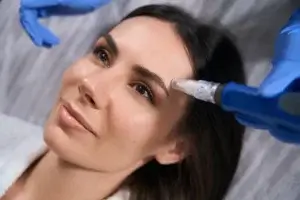
CO2 Laser Skin Resurfacing addresses all three concerns in a single process: controlled removal of damaged surface skin, followed by a collagen rebuild underneath. At Oceana Luxe Medspa, our providers reach for it when texture, lines, and scarring show up together.
A carbon dioxide laser vaporizes microscopic columns of sun-damaged tissue and sends heat deeper, prompting new collagen as the skin repairs. That repair softens resting lines, lifts depressed scarring closer to the surrounding skin, and smooths grainy texture. Improvement builds in stages, and the amount of change depends on treatment depth and how pronounced the concern is.
A fractional CO2 laser delivers carbon dioxide energy into the skin in a grid of microscopic columns, so only a fraction of the surface is treated in any single pass.
Both of those words matter. Ablative means the laser removes tissue outright, and that depth is why CO2 laser resurfacing reaches concerns gentler devices leave alone. Fractional means healthy skin remains between each treated column, and that surrounding tissue drives repair.
CO2 lasers are FDA-cleared for skin resurfacing. At Oceana Luxe Medspa, the treatment sits alongside our broader laser services in Corpus Christi for patients whose concerns run deeper than a facial can reach.
A single pass does two jobs at once. The damaged outer layer is removed in those columns, and controlled heat travels into the dermis, the living layer beneath the surface.
That heat is the point. It registers as a wound-healing signal, and the body responds by producing new collagen and elastin in the treated area.
Timing follows the same two-part logic. Surface improvement, brighter tone, and a smoother feel tend to show first as healing completes. The structural change builds underneath over the following weeks and months. Healing time is how this skin resurfacing treatment works.
Resurfacing works best on static rhytides, the clinical term for lines visible when your face is completely at rest. These creases are etched into the skin itself and visible in a still photograph.
The distinction matters practically. Lines driven by repeated muscle motion, like the horizontal forehead lines that appear when you raise your brows, respond to a different category of treatment, which is why our providers assess line type first.
For static lines, most patients see meaningful softening. A shallow crease often responds more completely than a deep one, and the realistic result is a line that sits shallower and catches less shadow.
Depressed acne scars are a texture problem at heart. The scar sits below the surrounding skin, catches shadow, and stays visible long after the discoloration fades.
The same collagen rebuilding addresses this. New tissue forms beneath the depression and gradually raises the scar floor toward the surrounding surface. Nothing is filled in from above.
Acne scarring typically softens and reduces, though it rarely disappears completely, and more significant scarring often requires more than one CO2 laser treatment to achieve full improvement. Surgical scars respond similarly, with results shaped by the scar’s depth and maturity.
Rough texture, enlarged-looking pores, sunspots, age spots, and dull tone all live in the same few layers of skin, which is why one resurfacing pass tends to improve them together.
Year-round Gulf Coast sun, weekends on Padre Island, and a climate where outdoor time never really pauses mean cumulative UV damage often shows up here earlier than patients expect.
Many patients arrive asking about wrinkles and leave most satisfied with the texture change.
Good candidates tend to share a profile: visible sun damage, uneven texture, static lines, or scarring, plus the flexibility to plan around a healing window.
Skin tone is part of the assessment, and it deserves a direct answer. Providers use the Fitzpatrick scale, a classification running from I for very fair skin to VI for very deep skin, to predict how skin responds to light-based treatment.
Laser skin resurfacing with a CO2 device is generally most suitable for fair to medium tones, since deeper tones carry a higher risk of post-inflammatory hyperpigmentation, meaning darkening that appears after the skin is disturbed. Recommending a different approach for deeper tones reflects clinical judgment about safety.
A few factors also require putting treatment on hold: an active skin infection or cold sores in the treatment area, pregnancy, certain photosensitizing medications, and recent isotretinoin use. Our team reviews all of this during a consultation for CO2 laser skin resurfacing in Corpus Christi, TX, and you can contact us about your situation before you commit to anything.
Everything CO2 laser does traces back to one process. It removes damaged tissue in a controlled pattern, prompts the deeper layer to repair, and uses the collagen produced during that repair to soften etched lines, lift depressed scarring, and refine rough texture. Change arrives in stages, and the honest outcome is clearer, smoother skin that still looks like your own.
The practical next step is an assessment, since a provider needs to see your skin in person to judge your Fitzpatrick type, the depth of your concerns, and the right treatment intensity for you. Ready to refresh your skin? Discover whether CO2 laser skin resurfacing is right for you. Book a consultation with Oceana Luxe Medspa today.
Morning light in a bathroom mirror is honest in a way that flattering restaurant lighting never is. It picks up the fine crosshatching across the

Facial expressions can gradually leave visible lines, especially across the forehead, between the brows, and around the eyes. Botox® and Dysport® for wrinkles target the